World History at a Glance: The Big Eras
A simple map of human history — the major eras, why each one mattered, and how to help it actually stick.
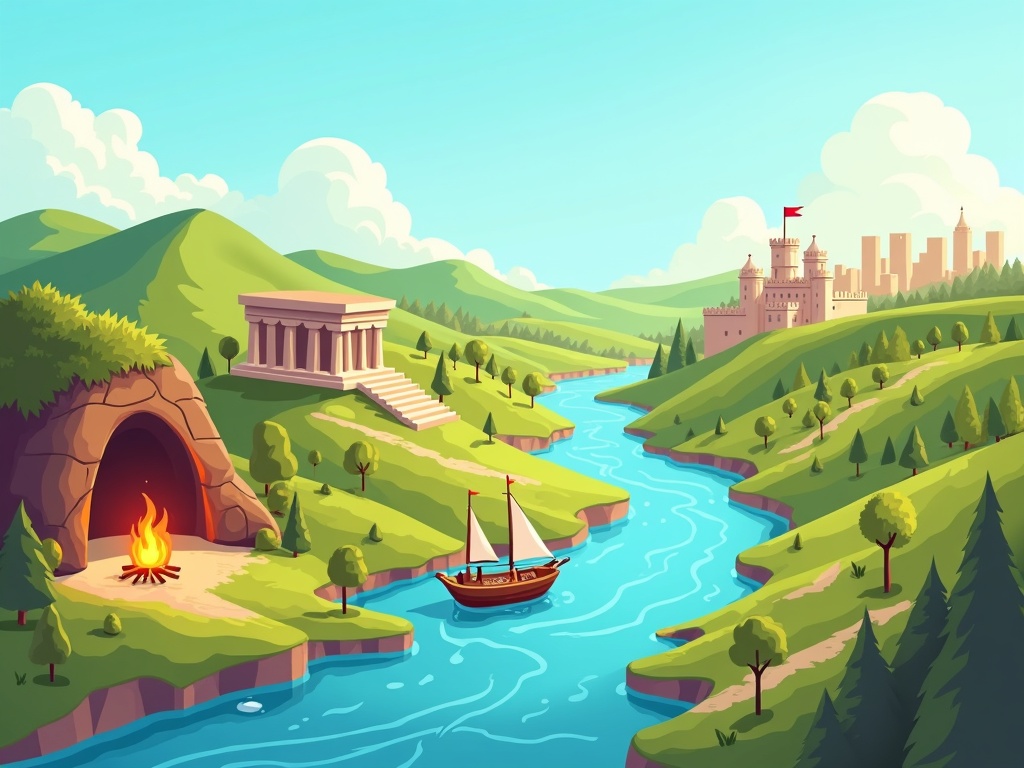
Before you dive into any one country or century, it helps to have the whole sweep in your head. Here’s the map I give my kids first — the big rooms of history, before we go exploring inside any single one.
I do it in this order on purpose. When a child already knows roughly where the Romans sit, or where the moon landing sits, a new story has somewhere to land. Without that map, every fact arrives homeless — one more disconnected thing to memorise. With it, the same fact clicks into place. Same information, completely different outcome.
The big eras
- Prehistory — humans learn to make fire, tools, art and language. This room is enormous, by the way. People lived here for hundreds of thousands of years, far longer than everything after it put together. That alone is worth sitting with.
- Ancient world — the first cities and the first writing: Mesopotamia, Egypt, the Indus Valley, early China. History, in the “we can read what they wrote” sense, starts here.
- Classical age — Greece, Rome, Persia and the great Asian empires, trading ideas (and armies) along the Silk Road. So much of how we still argue, govern and build traces back to this room.
- Medieval world — faiths spread, empires rise and fall, and for most people life stays stubbornly local. While Europe was in its “Middle Ages,” remember, the Islamic world was in a golden age of science and the Maya were building cities in the Americas. Different rooms, same moment.
- Age of connection — ships link the continents. For better and much worse, the world stops being lots of separate stories and becomes one tangled story.
- Modern era — revolutions, industry, world wars, and the fast, wired world your kids are actually growing up in. It’s a tiny slice of the timeline, and it’s where nearly everything they take for granted was invented.
The trick: “which room does this live in?”
Here’s the whole method, and it’s almost embarrassingly simple. We keep this list on the fridge. Whenever we bump into a bit of history — a pharaoh in a story, a knight in a film, a moon landing on a documentary — we ask one question:
“Which room of history does this live in?”
Placing it on the map is half the learning. My son doesn’t need to know the exact year the Colosseum was built to get something valuable out of it — he needs to know it belongs in the classical room, comfortably before knights and castles, and a very long way before phones. Get the rooms right and the years slot in later, almost on their own.
The other quiet lesson this teaches is proportion. Kids are genuinely surprised that “modern” is a sliver, and that prehistory is most of the wall. That surprise is the sound of history clicking into scale.
See it on a real timeline
A list on the fridge is a great start. To see these rooms laid out in order — with a picture for each moment and the story behind it — have a play with our interactive world history timeline. It’s the same map, but you can scroll the whole human story from the first humans to today.
And if you want to zoom into one country’s whole story on a single printable page, grab our free South Africa timeline:
Get this for free
Sign in with Google, Facebook or email to download.
Your download is ready
Download ⬇How we use it, day to day
We don’t “do a lesson” on this. It just lives on the fridge and gets pointed at. A story sparks the question, we place it in a room, and every so often that leads somewhere deeper — a rabbit hole about pyramids, or the Silk Road, or the space race. That’s exactly how it’s meant to work: the map isn’t the destination, it’s the thing that makes the destinations make sense.
The short version
Give kids the big rooms of history before the details, and every new fact finally has somewhere to go. Keep the list of eras somewhere they’ll see it, ask “which room does this live in?” whenever history pops up, and let the interactive timeline show them the whole sweep — and the surprising proportion — of the human story.

Have your say
Sign up or log in to join the conversation — share a tip, ask a question, or say what worked for you.