The Writer's Toolbox
A free printable poster that turns grammar into a writer's toolkit — verbs, similes, dialogue, the five senses and more — so kids ask “which tools can I use today?” instead of “what grammar must I remember?”
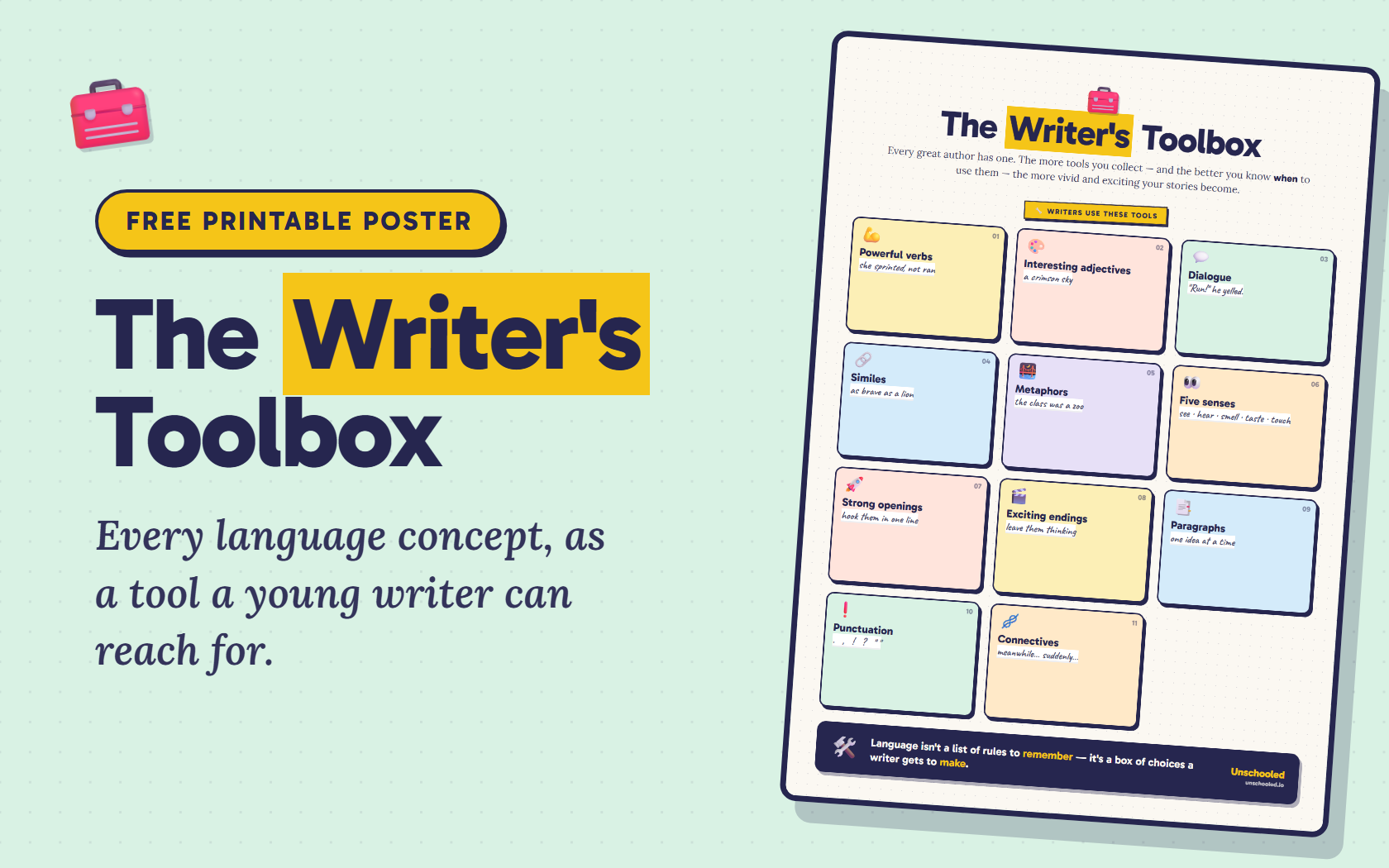
In school, language and writing get taught in separate boxes — grammar on one page, a story on another — and kids rarely see how they join up. This poster puts them in the same place: every language concept becomes a tool a writer can reach for. Stick it on the wall where they write.
Get this for free
Sign in with Google, Facebook or email to download.
Your download is ready
Download ⬇What’s inside
A three-page A4 printable (scale it up to A3 if you want it big on the wall):
- Page 1 — Your writing journey. The whole picture before they start: a five-stop road from plan it to share it, with the tools they’ll reach for at each stop and a pointer to the page where that step actually happens.
- Page 2 — Plan it before you write it. A fill-in planner: what the story is about, the characters every story needs (protagonist, antagonist, sidekick, mentor, supporting cast — with a circle to draw each face), the setting, and the story mountain — introduction, trigger, rising action, climax, falling action, ending.
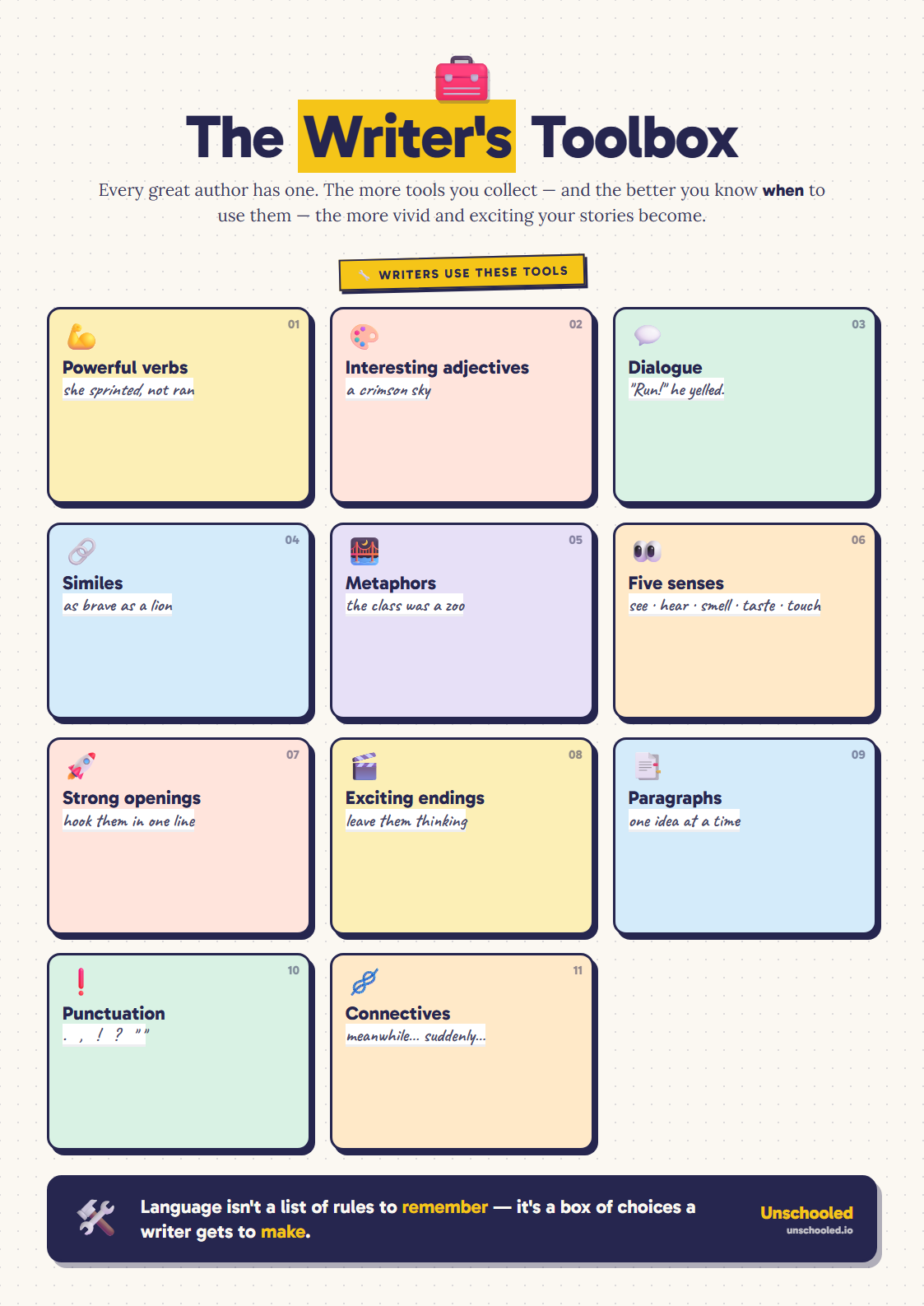
- Page 3 — Make it better. The eleven writer’s tools with a tiny example for each, grouped into three families — choosing words (powerful verbs, adjectives, the five senses), painting pictures (similes, metaphors, dialogue) and shaping the writing (strong openings, exciting endings, paragraphs, punctuation, connectives) — plus a blank card for a tool they name themselves. Each has a tick box and a line, so a child hunts through their own draft, ticks the tools they’ve used and writes the bit where they used it. A final edit checklist sits at the foot. This is the page to stick on the wall where they write.
How to use it
- Walk the road first. Page 1 is the map. Before any writing happens, let them see the whole journey — five stops, no surprises — so “write a story” stops being one enormous task.
- Plan on page 2. Who’s in it, where it happens, and the shape of the story mountain. Ten minutes here saves a lot of staring at a blank page.
- Draft freely. Get it all down. Nothing on these pages is about the first draft being right.
- Make it better on page 3. Hunt through the draft and tick each tool they’ve used, then go back and add two they’re missing. That’s the whole revision lesson, and it’s a hunt rather than a correction.
- Stick page 3 on the wall. The toolbox is only useful if it’s in sight when the page is blank.
The shift is small but it changes everything: instead of “what grammar must I remember?” kids start asking “which tools can I use in today’s story?” — because every great author has a toolbox, and the more tools you know (and when to use them) the more vivid your stories become.
Want the thinking behind it? Read We Teach Language and Writing Like They’re Strangers — on why grammar lessons and story-writing should never be separate.
Get this for free
Sign in with Google, Facebook or email to download.
Have your say
Sign up or log in to join the conversation — share a tip, ask a question, or say what worked for you.