Times Table Patterns — A Tool that kids love!
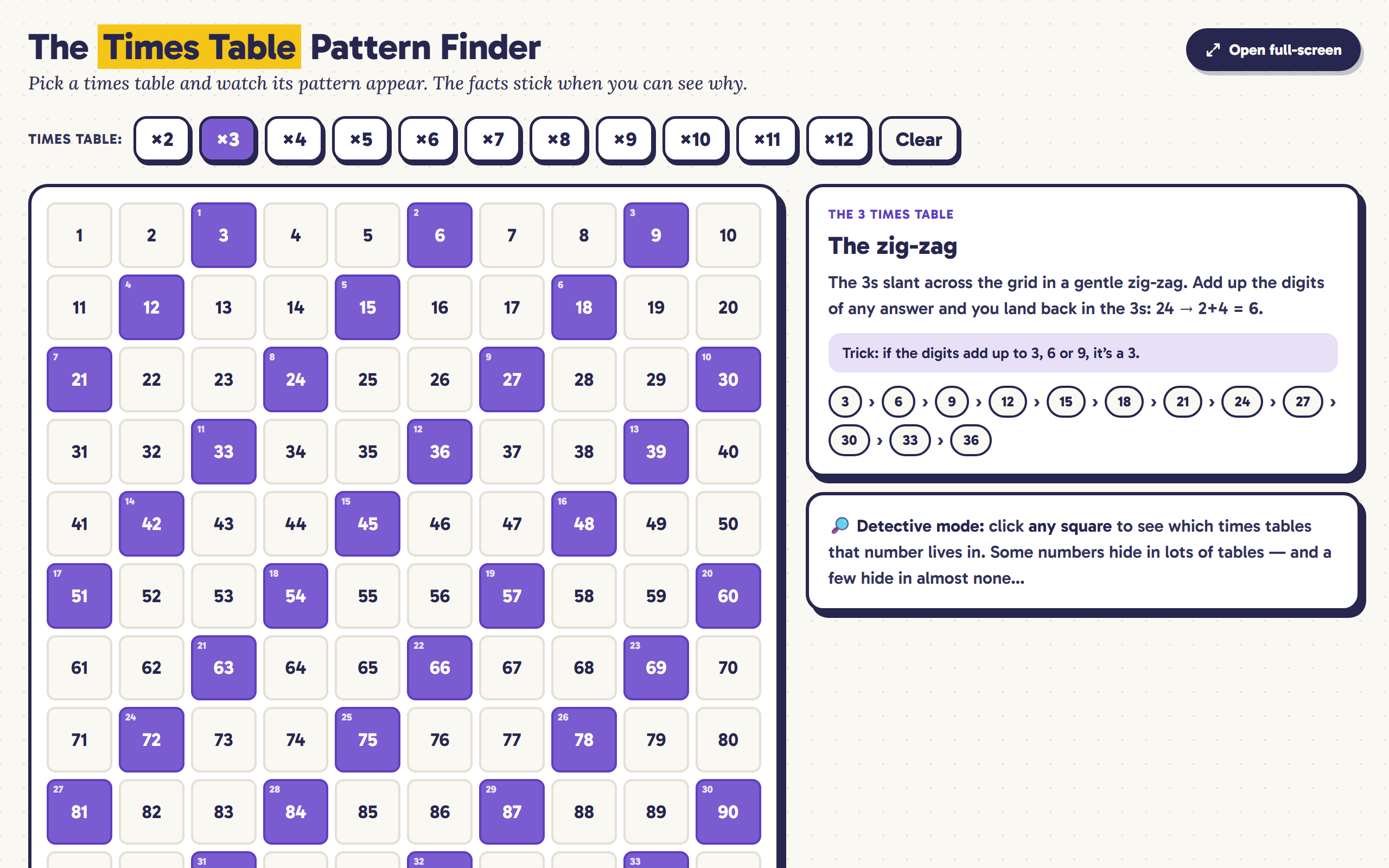
Play around with this interactive hundred-square where kids pick a times table and watch how the patterns light up. If they can see and understand the pattern, memorising times tables gets easier — because they can see it, and it makes sense.
I’m a firm believer that kids should know their times tables really well. I’ve
seen it in my own children — the struggle when they don’t know their tables and
the absolute win when they do, honestly it really makes a HUGE
difference. Knowing your times tables by heart isn’t about being “good at
maths.” It’s about being faster, and about freeing up room in your head. When
7 × 8 comes back instantly, there’s nothing left to juggle — all that mental
effort can go into the actual problem instead of the arithmetic underneath it.
This really shows once kids move on to more complex maths — the kind with several different problems and steps stacked inside one question. If they have to keep stopping to work out a multiplication or a division along the way, they lose track of where they were in the problem.
Times tables quietly sit underneath a huge amount of the maths that comes later. Once recall is instant, all of this gets easier:
- Long division — every single step leans on knowing multiples quickly.
- Multi-digit multiplication — the whole method is just single facts, stacked up.
- Fractions — simplifying and finding common denominators is really spotting shared factors.
- Ratios, rates & proportion — scaling up and down is times-tables thinking.
- Percentages — “15% of 60” is quick when the tables are already there.
- Factors, multiples & primes — you can’t hunt for factors you don’t recognise.
- Area & volume — every rectangle’s area is a multiplication.
- Algebra, later on — expanding and factorising brackets is times tables with letters.
Knowing your times tables matters most for the kids who find holding several steps
in mind the hardest — including many children with ADHD. A working memory that’s
busy recalculating 6 × 4 for the third time has none to spare for the word
problem wrapped around it — or even the simple next step before the final answer.
But here’s the thing: drilling flashcards is the slow way in. The facts stick far better when a child sees why they’re true. Every times table draws a shape. Pick one below and watch it appear.
Tap Open full-screen for the whole window, or just start tapping tables right here.
What your kids will notice
- The 9s are magic. The tens climb (1, 2, 3…) while the ones fall (8, 7, 6…), and the two digits always add up to nine. Once they see it, they never forget it.
- The 5s are the easiest pattern on the grid — two tidy columns, every answer ending in 5 or 0.
- Every fact appears twice.
3 × 8and8 × 3land on the same number, so learning one gives you the other free. That quietly halves the whole job. - Some numbers hide in loads of tables. Click 24 in detective mode — it turns up in the 2, 3, 4, 6, 8 and 12 tables. That’s why it feels so familiar.
- Primes are the loners. Click 7 or 13 — no table from 2 to 12 ever lands on them. That “refusing to fit” is exactly what makes a number prime.
Turn it into a challenge
Give them a question and let the grid answer it:
- Which times table makes a straight diagonal line? (Try the 11s.)
- Find a number that lives in five different tables. (There are a few — 24, 36, 48…)
- Pick two tables that share lots of numbers. (The 2s and the 4s — because 4 is double 2. Which others overlap?)
- Which single-digit number is a prime? Hunt for the ones no table lights up.
The goal isn’t speed today. It’s the moment a child stops asking “what’s the answer?” and starts noticing “wait — these numbers make a pattern.” Once maths becomes something you can see, the memorising takes care of itself.
Have your say
Sign up or log in to join the conversation — share a tip, ask a question, or say what worked for you.