The South African History Timeline — The Whole Story on One Line
An interactive timeline of South African history, Grades 4–12 — the local story and the world events it's taught alongside in school, in the order they really happened. Tap any grade to see what it covers, from hunter-gatherers to democracy.
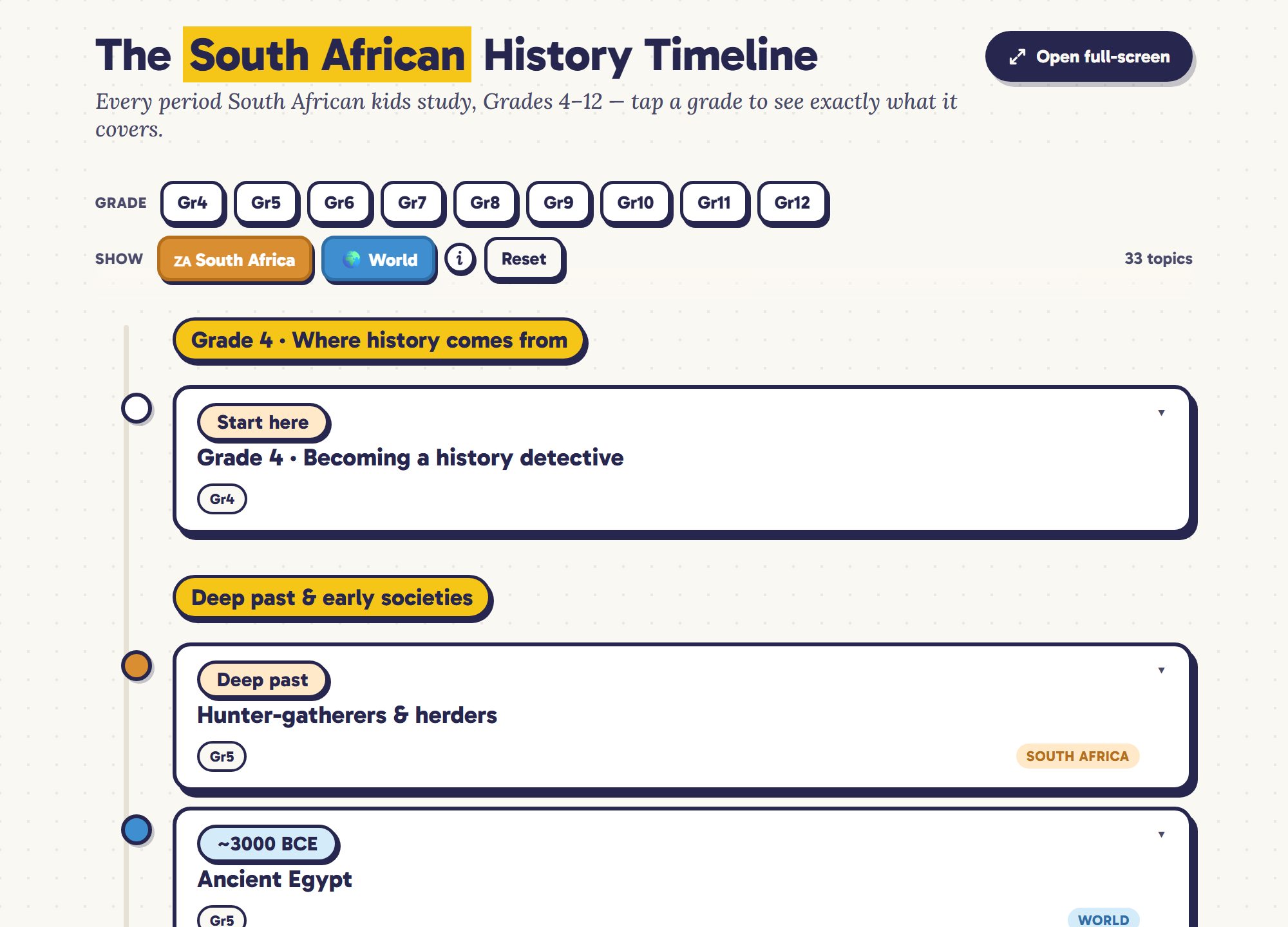
South Africa’s history is a huge story — and the way it’s taught in school doesn’t run in a straight line. One term your child is in Ancient Egypt, the next in apartheid South Africa; the French Revolution sits a grade away from the Mineral Revolution. It’s easy for kids (and parents) to lose the thread of when things actually happened and how it all fits together.
So I put the whole thing on a single timeline. Every period South African children study from Grade 4 to Grade 12 — the local story and the world events it’s taught alongside — in the order it really happened. Tap a grade to light up exactly what that year covers.
Tap Open full-screen for the whole window, or use it right here.
How to use it
- Tap a grade (Gr 4–Gr 12). Everything else fades back so you can see just that grade’s topics — and where in history they sit. Great for “what are we covering this year?” or seeing how Grade 9 and Grade 12 revisit the same liberation story at different depths.
- Toggle South Africa / World. The 🇿🇦 and 🌍 buttons show or hide each strand, so you can trace just the South African thread, or just the global one.
- Tap any card to open the short story behind it, with a link to read more on South African History Online.
What’s on it
The whole sweep, in order: hunter-gatherers and the first farmers, the kingdom of Mapungubwe, Mali and Timbuktu, the arrival of European explorers and the colonisation of the Cape, the French Revolution, the Mfecane and the Great Trek, the Mineral Revolution and the Scramble for Africa, two World Wars, the Russian Revolution and the Great Depression, the Cold War, the rise of apartheid and the long struggle for freedom — right through to 1994 and democracy.
Turn it into a study tool
- Before a new term, filter to your child’s grade so they can see the shape of what’s coming — and how it connects to what they already know.
- Play “what else was happening?” — when you land on a South African event, switch World on and see what the rest of the planet was doing at the same moment.
- Use it as a revision spine: work down the timeline and see how much of each card’s story your child can already tell before they open it.
Curriculum structure follows the official Department of Basic Education CAPS documents (History Grades 10–12; Social Sciences Grades 4–9). The history behind each entry draws on South African History Online.
Have your say
Sign up or log in to join the conversation — share a tip, ask a question, or say what worked for you.